
SNUBA® in Bonaire: Underwater Without a Diving Certificate
SNUBA, a licensed program between snorkeling and diving, offered as a 4-hour boat tour by SNUBA Bonaire, the first and only SNUBA operator on the island. Morning and afternoon tours. The system was invented in 1989 and patented in 1990 in Bonaire, departing from Nautico Marina in Kralendijk, usually diving at Andrea I and II.
SNUBA® sits somewhere between snorkelling and diving. No dive certification is needed. SNUBA® Bonaire is the first and only SNUBA® operator on Bonaire. Below you can read more about SNUBA® itself and about how Patrick and Heidi of SNUBA® Bonaire run it on Bonaire.
What is SNUBA®?
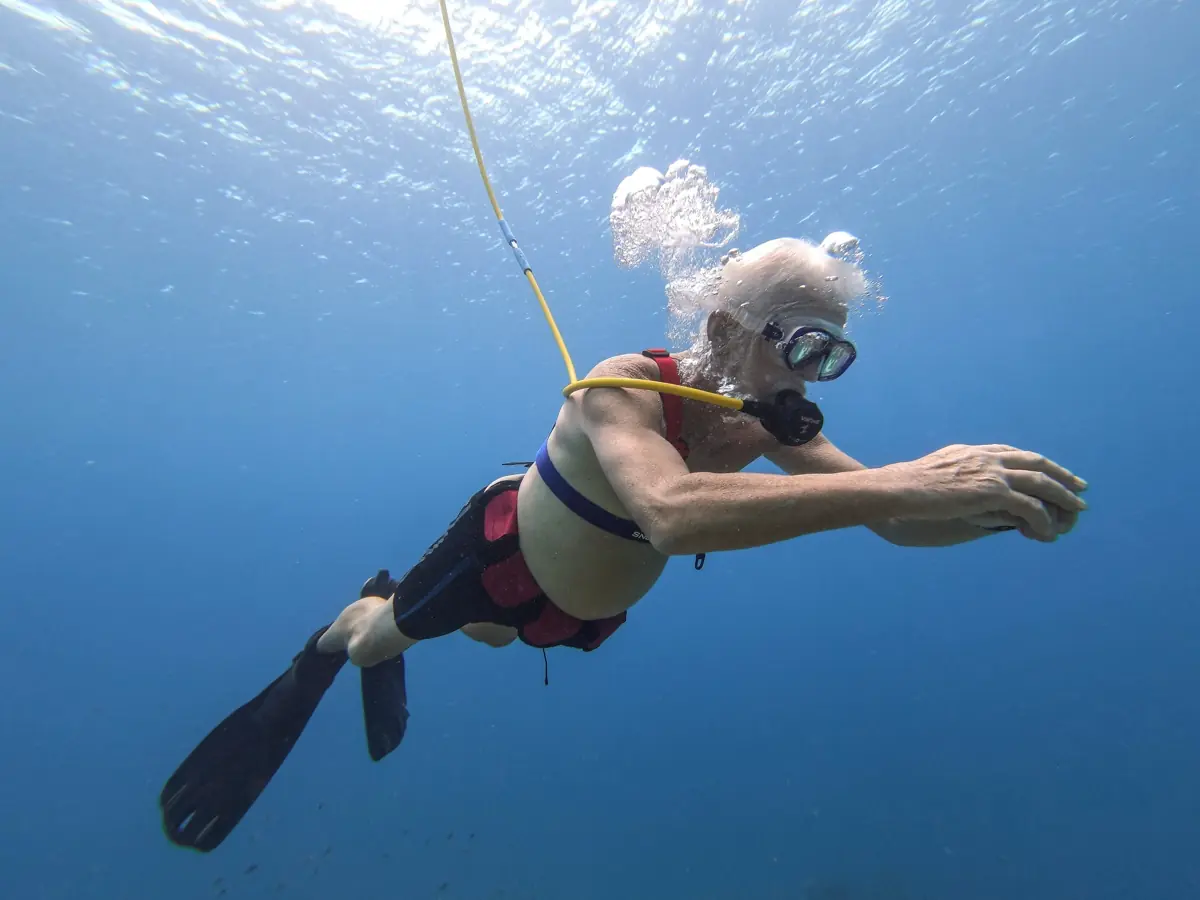
SNUBA® sits somewhere between snorkelling and diving. The system was devised in 1989 by Californian diver Michael Stafford and patented in 1990 by SNUBA International in the United States, which also owns the trademark. SNUBA® has therefore been around for more than 35 years.
SNUBA® is not a product you can buy, but a licensed programme. It is only offered by operators licensed by SNUBA International who work according to its procedures, safety protocols and standards. The guides are also trained and certified by SNUBA International.
Other systems that supply air from the surface can also be found on the market, often using a compressor at the surface. These do not operate under a proven safety programme such as that of SNUBA International, and SNUBA® Bonaire explicitly distances itself from them.
SNUBA® is offered worldwide, including in Hawaii, Florida, Mexico, St. Lucia, the Virgin Islands, Turks and Caicos and at various other locations in the Caribbean. And, as of recently, on Bonaire too.
How does SNUBA® work technically?
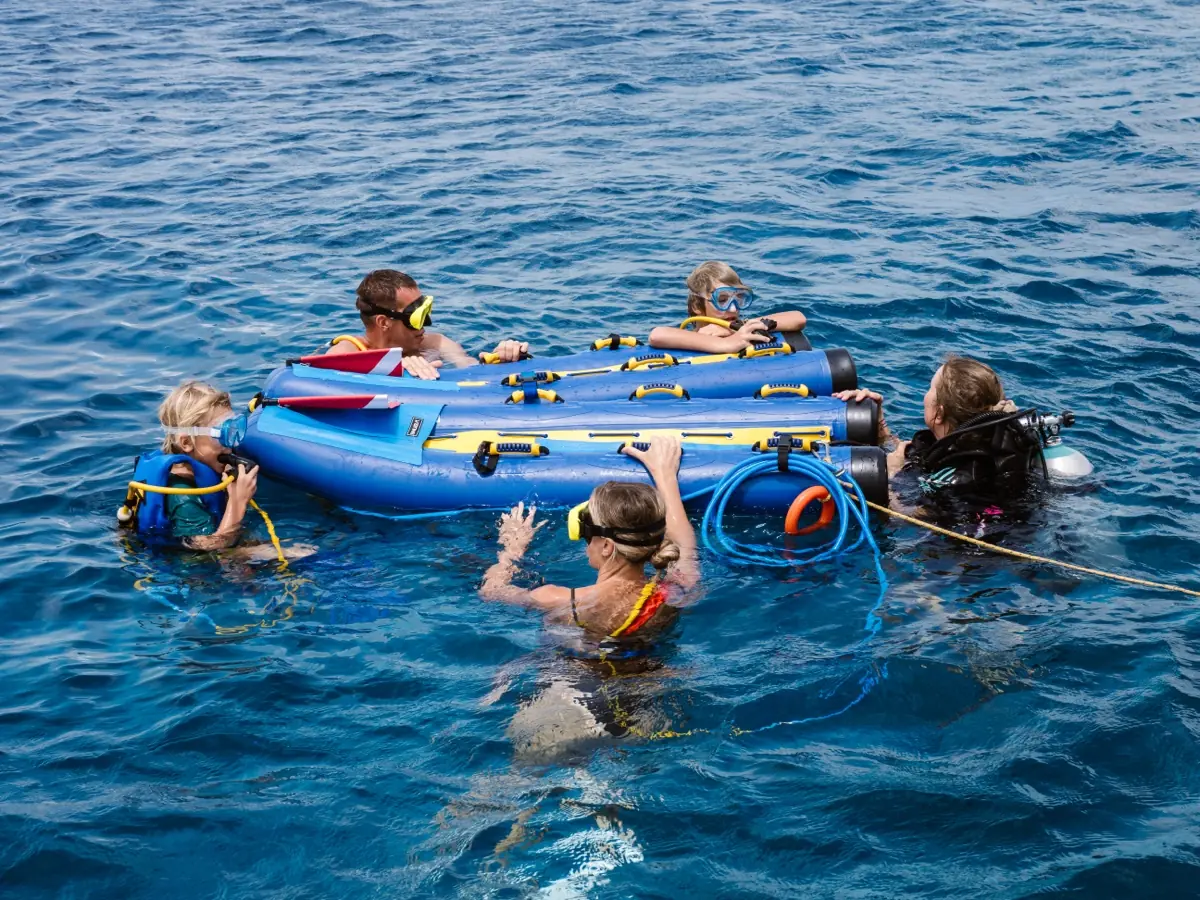
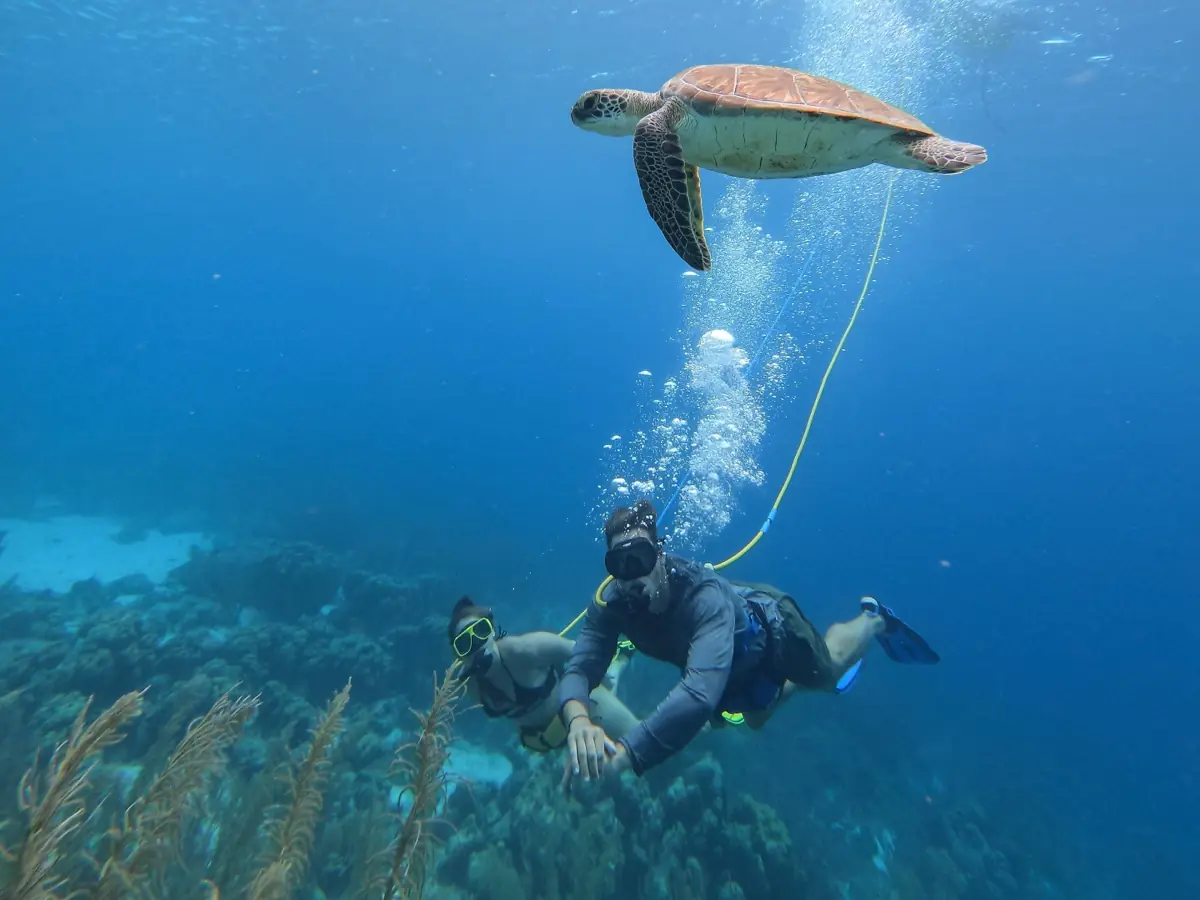
- The dive tank is not on the participant's back, but on a specially designed raft that floats on the surface and moves along with the participant.
- An air hose of 6 metres (officially 20 feet) runs from the raft to the participant, who breathes through a standard dive regulator. All breathing equipment, first and second stage, is from Aqualung, the permanent partner of SNUBA International.
- The hose is attached to a light harness. In addition, the participant wears a mask, fins and a weight belt with weight pockets filled with soft lead.
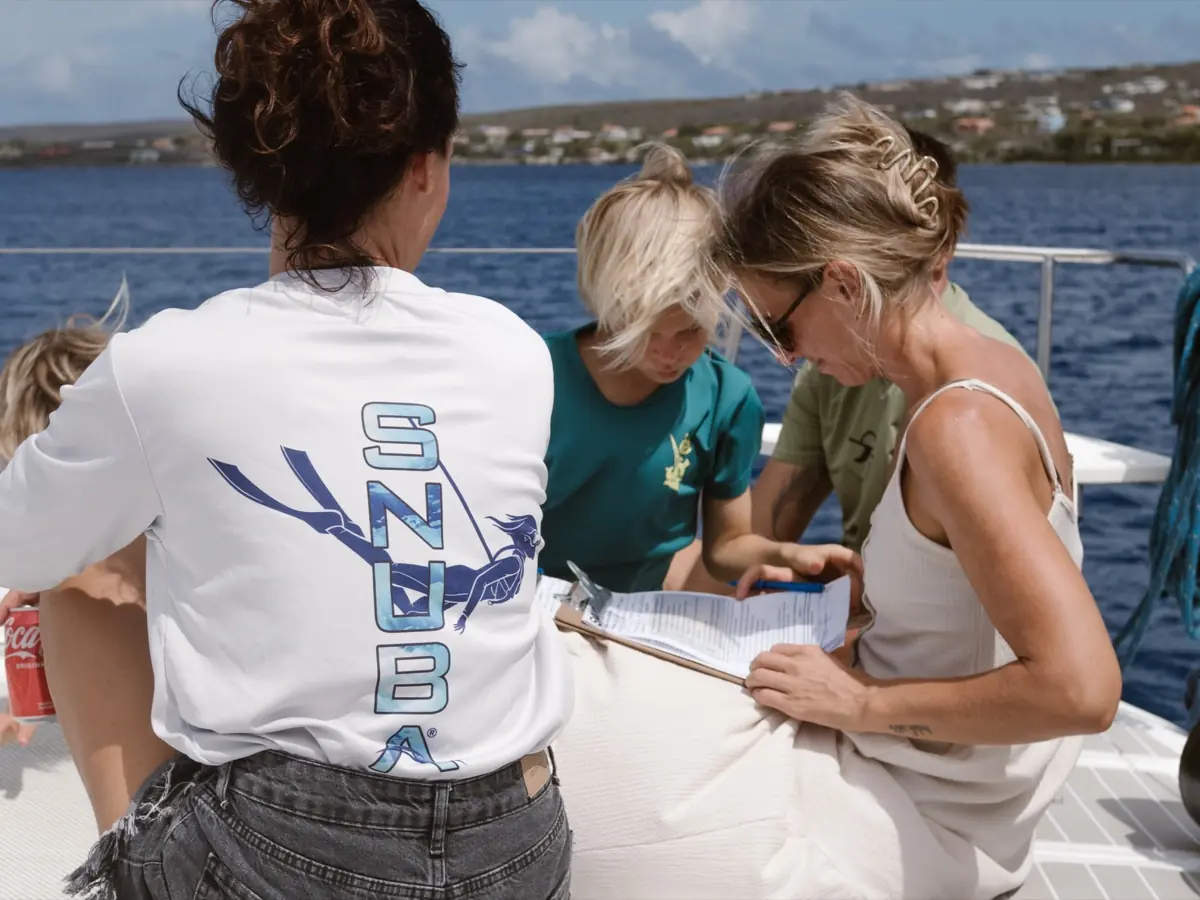
- No dive certification is needed. Every participant does fill in a medical questionnaire and a waiver beforehand.
- A certified SNUBA® guide always accompanies you into the water.
Everyone does everything at their own comfort level
This motto is central to SNUBA®. You don't have to do anything, you may do anything. You can stay at the surface, go down to 6 metres or stay somewhere in between. If someone feels comfortable at 2 metres, they stay at 2 metres.
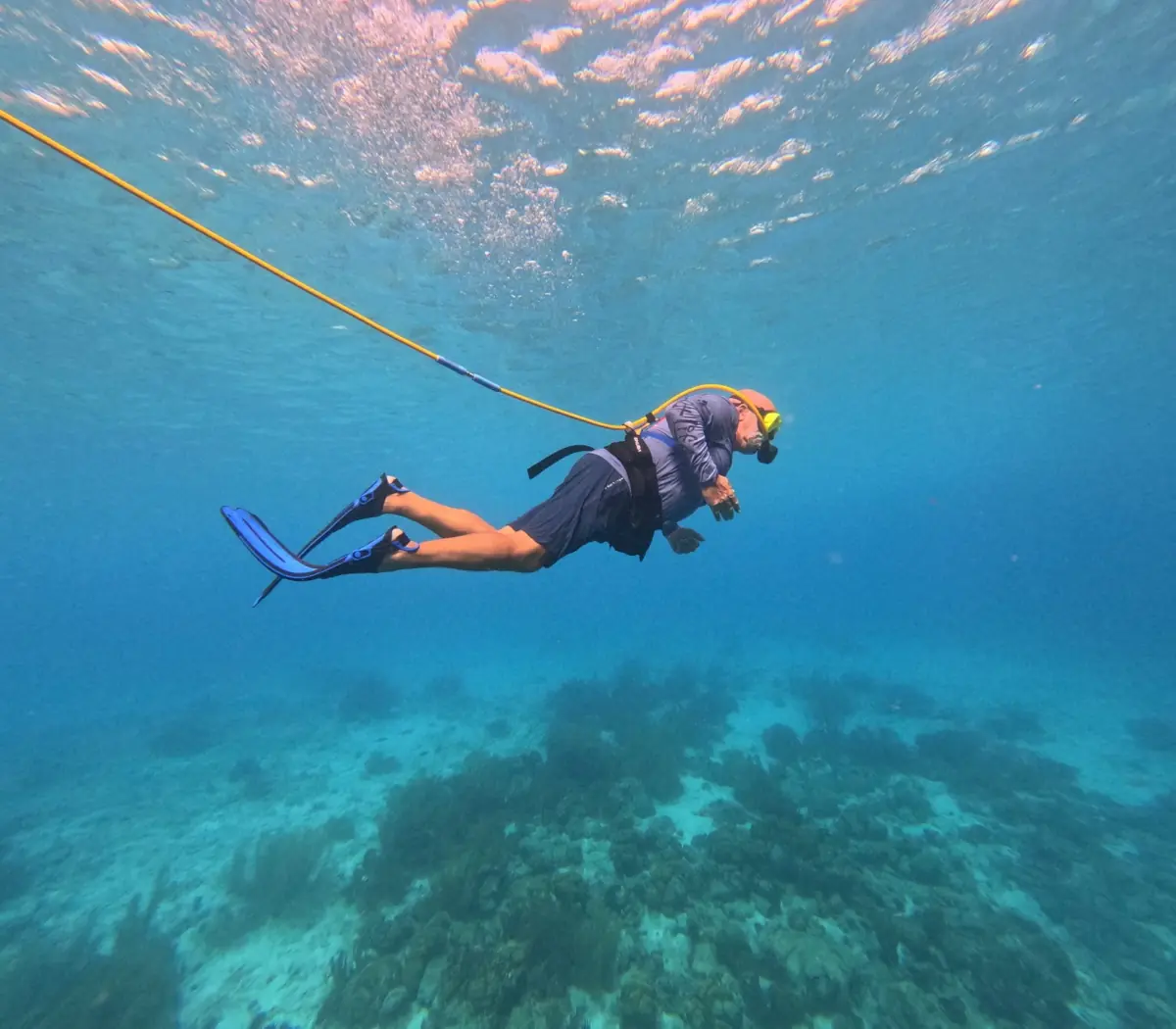
The hose plays a big part in this. Participants can simply hold the hose and use it to determine their own depth. This is also how SNUBA® Bonaire instructs them. This removes the most difficult elements of diving for someone going underwater for the first time.
The hose also gives many people a secure feeling: they stay literally connected to the surface. That mental aspect is perhaps the greatest strength of SNUBA®.
SNUBA® safety
SNUBA® has a very good safety record, including in comparison with recreational diving. For official figures and statements on this, SNUBA® Bonaire gladly refers you to SNUBA International itself (snuba.com).
How SNUBA® came to Bonaire
It started with a colleague of Patrick's, originally from Key West. She had worked there for one of the largest SNUBA® operators in the United States. When she moved to Bonaire, she couldn't understand why SNUBA® didn't exist there yet: an island with calm, clear water and a reef that starts right off the shore. And yet non-divers could see that reef almost only from above. In her view, SNUBA® was the perfect product for Bonaire.
Patrick didn't know SNUBA® himself yet, but when she showed him the concept, he was immediately convinced. Together they decided to start a business and bring SNUBA® to Bonaire.
Just when the company was being established at the notary and the papers were due to be signed, she decided to leave the island. That came as a shock, but the idea was too good to let go. Patrick decided to carry on and, together with Heidi, he built the project into what SNUBA® Bonaire is today: the first and only SNUBA® operator on Bonaire.
The catamaran Mushi Mushi
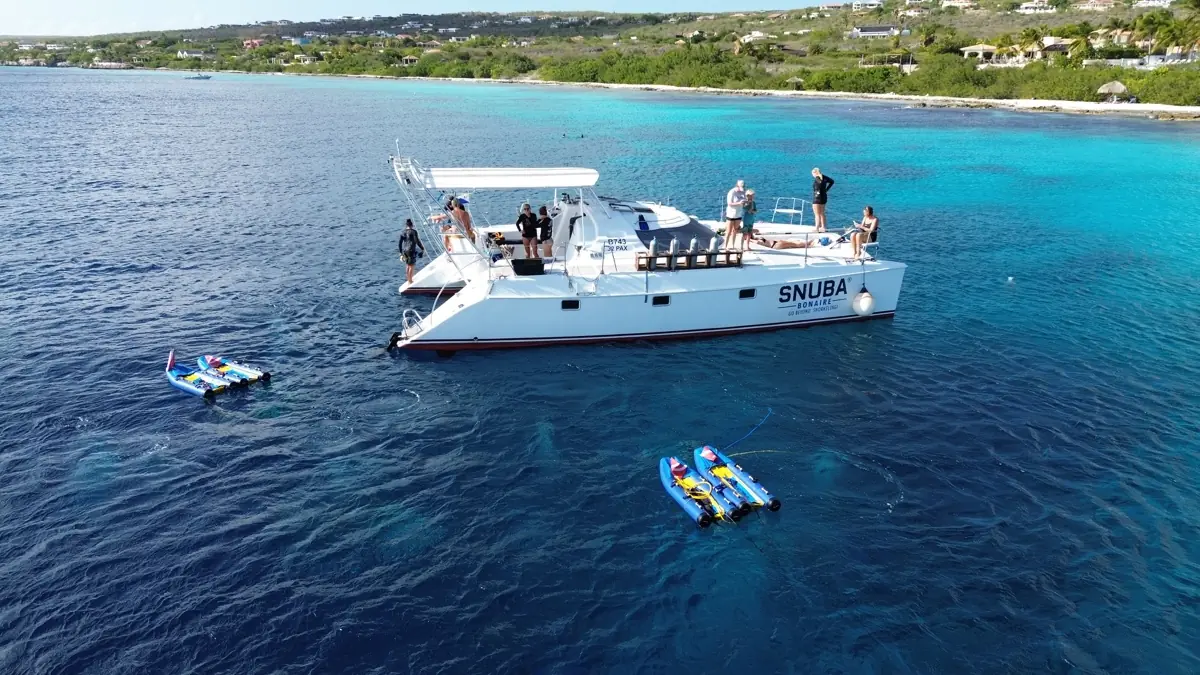
Setting up the business also meant getting a boat ready. The catamaran Mushi Mushi spent two and a half months on land for a complete refit. With a little help, Patrick worked on it seven days a week, from six in the morning until nine at night.
The exterior of the boat has been completely refurbished and repainted, it has been given new antifouling and the deck has been refitted. Inside, everything was stripped out (from water hoses to electrics) and the boat was essentially rebuilt from scratch.
The SNUBA® tour on Bonaire
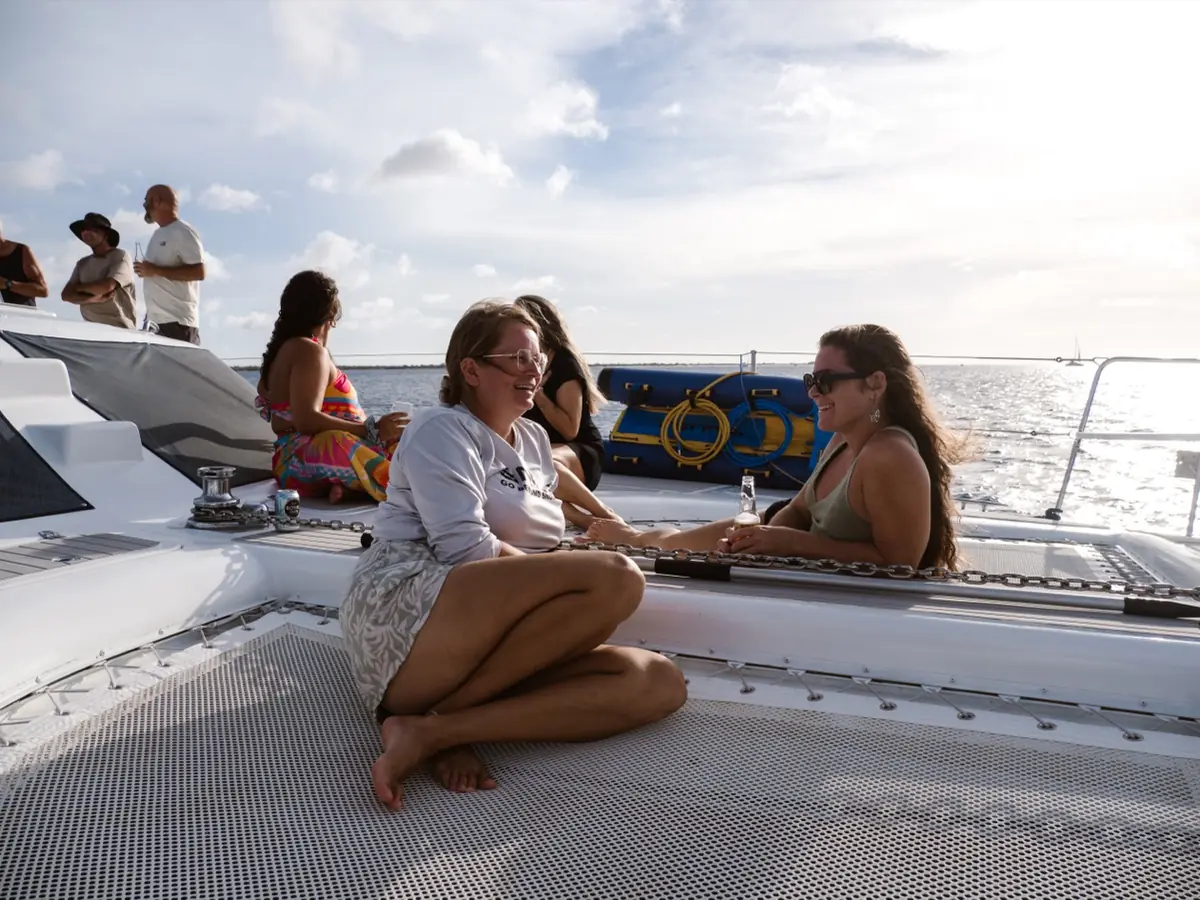
SNUBA® Bonaire offers SNUBA® on Bonaire as a 4-hour tour aboard the Mushi Mushi, departing from Nautico Marina in Kralendijk. There are morning and afternoon tours.
The tour consists of a relaxed cruise along the coast, the SNUBA® dive, time for free snorkelling and a relaxed return trip. All SNUBA® and snorkelling equipment is included, as well as drinks and a nicely prepared snack platter on board.
For more information and bookings, visit snubabonaire.com.
How SNUBA® Bonaire runs it
- Small groups: in the water, one guide supervises a maximum of four participants.
- Taking it easy on the way: SNUBA® Bonaire deliberately sails at a relaxed pace along the coast to the dive site. For many people this is their first diving experience, and that can be exciting. Guests need to trust their guide and feel at ease. During the trip, guests and guides get to know each other, guests can ask all their questions and they settle down. This is how SNUBA® Bonaire keeps the threshold as low as possible.
- Briefing and exercises: at the site, a thorough safety briefing and exercises in the water follow.
- The SNUBA® dive: how long the dive lasts depends on the participants' air consumption. A fixed minimum amount of air always remains in the tank as a safety margin. Participants don't have to keep track of this themselves: the guide monitors the air supply throughout the dive and gives the signal to ascend as soon as that limit is reached. This margin is never exceeded under any circumstances.
- Afterwards: there is time for free snorkelling, and on the way back guests share their experiences on board.
- Snorkelling or power snorkelling: not everyone has to dive. A power snorkeller breathes through the regulator at the raft, but wears no weights and therefore stays at the surface.
- Age: the minimum age is 8 years.
The dive site
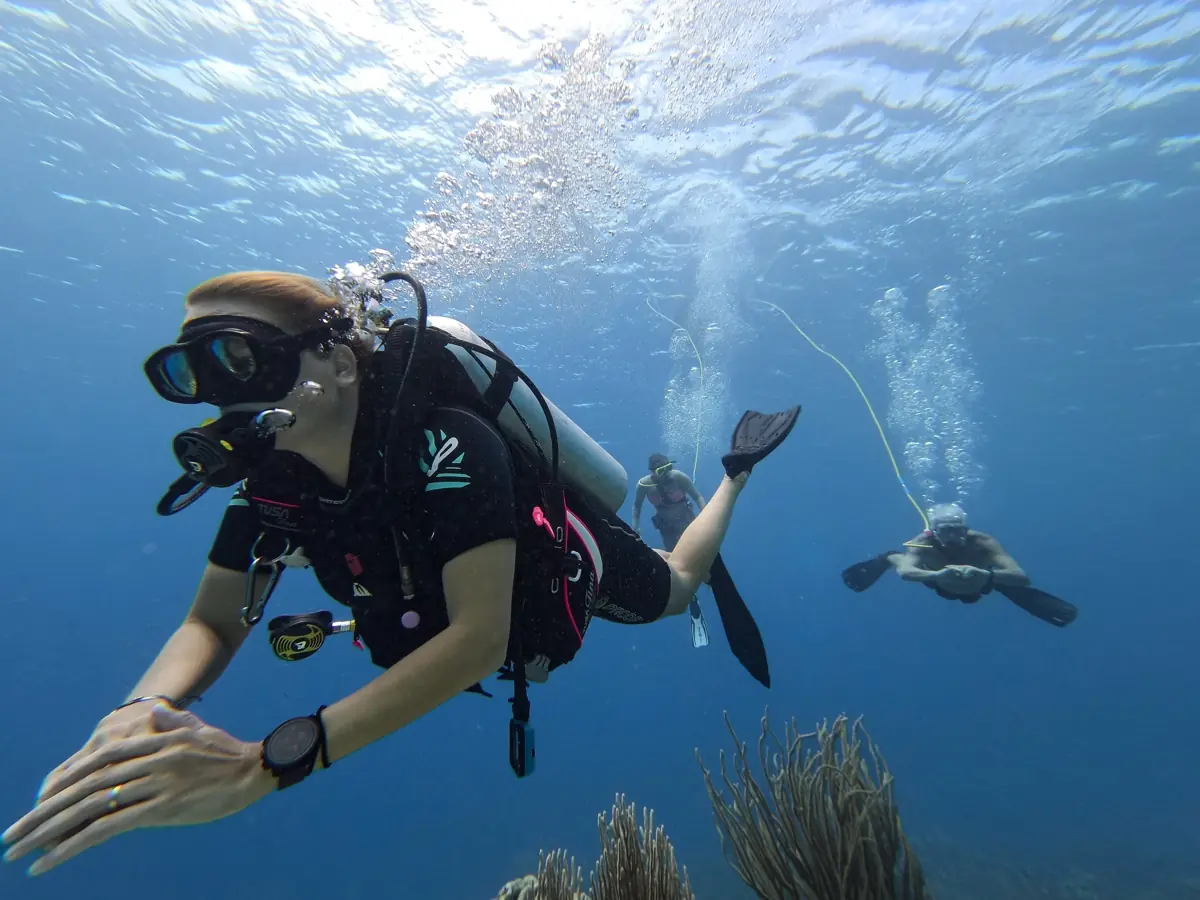
The location can vary from day to day, but the tour usually goes to Andrea I and II. There is generally hardly any current or surf there, and the reef is relatively shallow, so participants really get to see something. SNUBA® Bonaire always keeps everyone at a generous distance from the reef, so that it is never touched.
There is a great variety of fish and corals. You'll see many of the species you encounter on Bonaire and, with a bit of luck, some rarer ones too. At Andrea II there are also coral trees from Reef Renewal Foundation Bonaire, a coral nursery. SNUBA® Bonaire gladly shows these to its guests.
Nature and awareness
The Bonaire National Marine Park has existed since 1979 and is considered one of the first underwater parks in the world. The park protects all the waters around Bonaire and Klein Bonaire (from the high-water line to a depth of 60 metres) and is managed by STINAPA Bonaire. Reef Renewal Foundation Bonaire has been working since 2012 to protect and restore the coral reefs around the island.
Because SNUBA® Bonaire works in small groups and takes a personal approach, it can talk about the reef and the Marine Park in an accessible way. SNUBA® Bonaire literally takes people underwater (closer to the park) and uses that moment to raise awareness. Coral should not be taken for granted, and the reef is perhaps the most important thing Bonaire has.
From non-diver to diver
SNUBA® bridges the gap between non-divers and divers. Patrick and Heidi regularly see couples and families on board (where one dives and the other doesn't) who can now experience it underwater together.
What excites Patrick and Heidi most is turning non-divers into divers. Someone has their first diving experience with SNUBA® Bonaire and then takes the next step at a local dive school, with a Discover Scuba Dive or an Open Water certification. That is not only great for that person, but also for Bonaire as a diving destination.
SNUBA® Bonaire information
www.snubabonaire.com
+599 7854052
At a glance
- What
- SNUBA, a licensed program between snorkeling and diving, offered as a 4-hour boat tour by SNUBA Bonaire, the first and only SNUBA operator on the island.
- When
- Morning and afternoon tours. The system was invented in 1989 and patented in 1990.
- Where
- Bonaire, departing from Nautico Marina in Kralendijk, usually diving at Andrea I and II.
- Who
- Patrick and Heidi of SNUBA Bonaire, certified SNUBA guides, and participants aged 8 and older without a diving certificate.
- Why
- To let non-divers see the reef underwater, lower the barrier to a first dive experience, and raise awareness of the reef and the Bonaire National Marine Park.
- How
- Air comes from a tank on a floating raft through a 6 meter hose to a regulator. Groups are small, start with a safety briefing and exercises, and a guide monitors the air supply.
Key facts
- SNUBA sits between snorkeling and diving and needs no certificate.
- SNUBA was invented in 1989 by Californian diver Michael Stafford.
- SNUBA International patented the system in 1990.
- The air hose is 6 meters (20 feet) long.
- One guide supervises a maximum of four participants in the water.
- The tour lasts 4 hours and departs from Nautico Marina, Kralendijk.
- Minimum age is 8 years.
- The usual dive site is Andrea I and II.
Frequently asked questions
Do you need a diving certificate for SNUBA on Bonaire?
Do you need a diving certificate for SNUBA on Bonaire?
How does SNUBA work?
How does SNUBA work?
How deep do you go with SNUBA on Bonaire?
How deep do you go with SNUBA on Bonaire?
What does the SNUBA tour on Bonaire include?
What does the SNUBA tour on Bonaire include?
What is the minimum age for SNUBA on Bonaire?
What is the minimum age for SNUBA on Bonaire?
Keywords
- SNUBA Bonaire
- onder water zonder duikbrevet
- SNUBA tour Bonaire
- snorkelen of duiken Bonaire
- eerste duikervaring Bonaire
- Mushi Mushi catamaran
- Andrea I en II Bonaire
- Bonaire National Marine Park