
From the Great Lakes to Bikini Atoll: a dream come true
Interview with technical diver Bas Poelmann about his wreck diving expedition to Bikini Atol, which he presents at Duikvaker 2027. Presentation on Saturday 6 or Sunday 7 February 2027 at 11:00. Duikvaker runs 5 to 7 February 2027. The atomic tests took place in 1946 in Stage 1 at Duikvaker. The expedition took place at Bikini Atol in the Marshall Islands, Pacific Ocean.
At last year's Duikvaker, technical diver Bas Poelmann took us to the ice-cold, deep waters of the Great Lakes. This year he is taking a completely different tack.
At the upcoming edition of Duikvaker (on 5, 6 and 7 February 2027), he will share his latest adventure: an expedition to the legendary Bikini Atoll. It is an absolute top location, packed with history and monumental shipwrecks. We spoke to Bas about this ultimate trip in advance.
Bas, last year you were at Duikvaker telling us about your adventures in the Great Lakes. This year you are taking us to a completely different corner of the world: Bikini Atoll. Has a new diving dream come true for you? Why is this particular atoll so high on the bucket list of every hardcore wreck diver?
"Bikini Atoll is one of the most remote places on earth. It was precisely because of that extreme isolation that the Americans decided to hold atomic tests there in 1946. As targets, they chose their own surplus navy fleet, which they sank with two atomic bombs. Where else in the world do you find American submarines, destroyers and an aircraft carrier lying so close together that you can dive them? On top of that, there are also captured German and Japanese warships, such as the Prinz Eugen and the HIJMS Nagato. It was from the latter ship that the Japanese Admiral Yamamoto gave the order to attack Pearl Harbor, which finally drew America into the Second World War. It is a location that is simply overflowing with history."
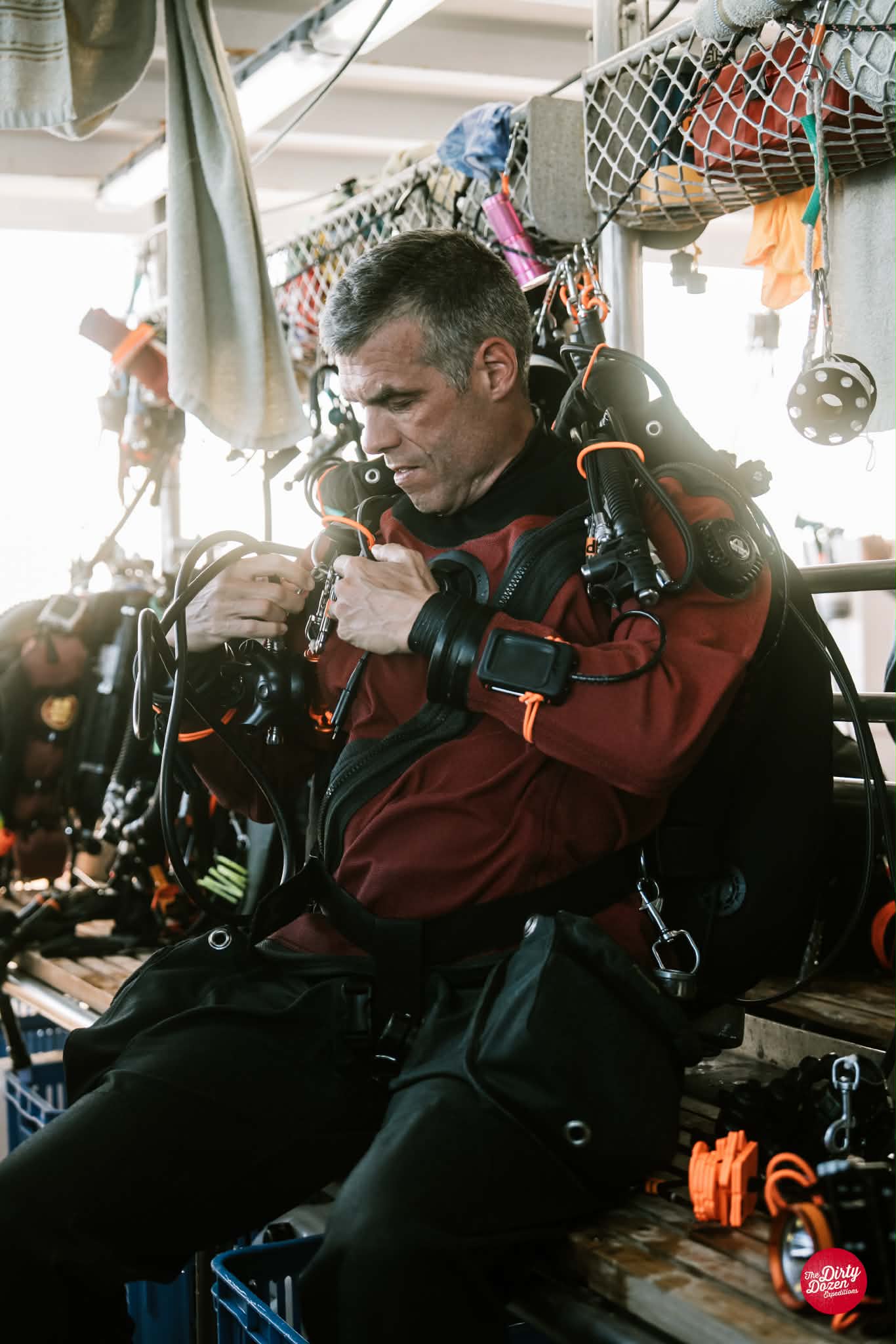
 You were there with the well-known Dirty Dozen Expeditions, under the experienced leadership of Mark Powell. What is it like, as a wreck enthusiast, to be part of such a specialist expedition to one of the most remote dive sites in the world?
"Because it is so extremely remote, getting there at all is a huge logistical challenge, let alone arranging everything for demanding technical divers. There is absolutely nothing on location. Everything a group of divers needs for ten days has to be brought along on the ship. That requires an enormous amount of specialist knowledge. So it is very reassuring to be travelling with experts who know the ropes and have done this before."
Bikini Atoll is not exactly around the corner; it is a tiny dot in the vast Pacific Ocean. Can you take us through the journey? How complex is the logistics of reaching this remote area and boarding the expedition boat?
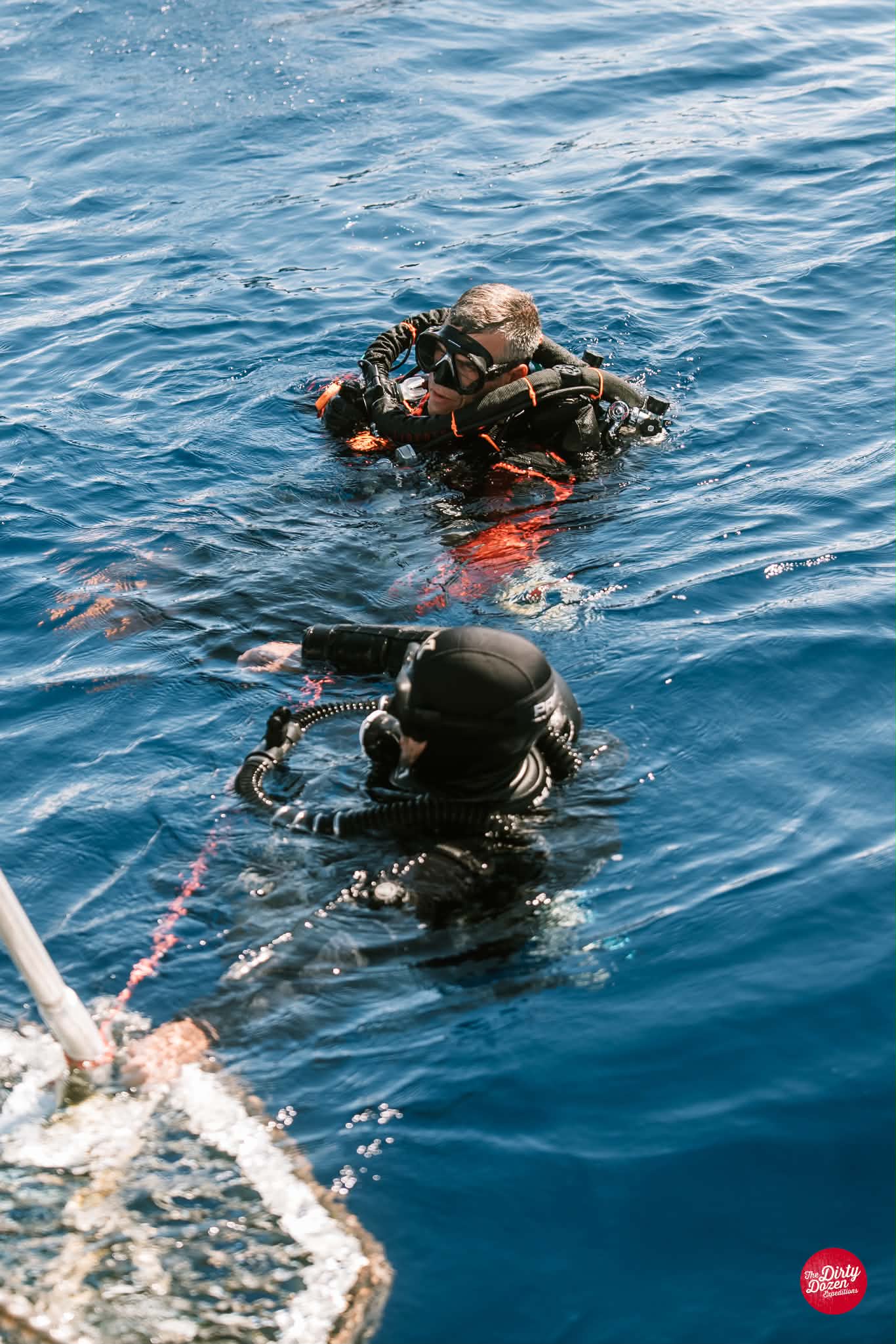
"It takes a full five days of travelling to get there. My flight route went from London via Los Angeles and Honolulu to Majuro, finally landing on Kwajalein. That last island is an American naval base, which means you are absolutely not allowed to stay there. You are put straight on a ferry to the neighbouring island of Ebeye. The plan was to acclimatise there in the island's only hotel, so that any delayed luggage would also have time to arrive. Unfortunately, that hotel burned down completely a few weeks before we arrived. As an alternative, the tour leaders had fortunately rented a luxurious villa for six. At that point there were eleven of us divers, so it was a cosy bit of improvising! After two days we were finally able to board the expedition ship, after which it was still about thirty hours of sailing to Bikini itself."
Before we descend to the wrecks: Bikini Atoll carries a pitch-black historical burden. Can you briefly take us back to 1946? What happened there during Operation Crossroads?
"The Second World War had just ended after the Japanese surrender, which followed the atomic bombs on Hiroshima and Nagasaki. The Americans wanted to test this new, destructive weapon further and, above all, flex their muscles to the world. They assembled a fleet of more than a hundred ships (partly surplus vessels of their own, partly captured from the Germans and Japanese) for Operation Crossroads.
The first test, Able, was an atomic bomb dropped from an aircraft. The second, Baker, was detonated underwater, suspended beneath a work vessel. Media attention was enormous; countless journalists had been invited, and an estimated one fifth of all the film cameras in the world in 1946 were on site to record the tests.
At first the tests seemed a failure: Able sank only five ships and Baker six. In hindsight, however, the impact turned out to be invisibly huge: all the remaining ships had become heavily radioactive. Sailors were given boots and brooms and told to 'wash' the ships to remove the radiation. That failed completely. The ships were permanently unusable and put out of action. Most were eventually towed away and sunk elsewhere after all."
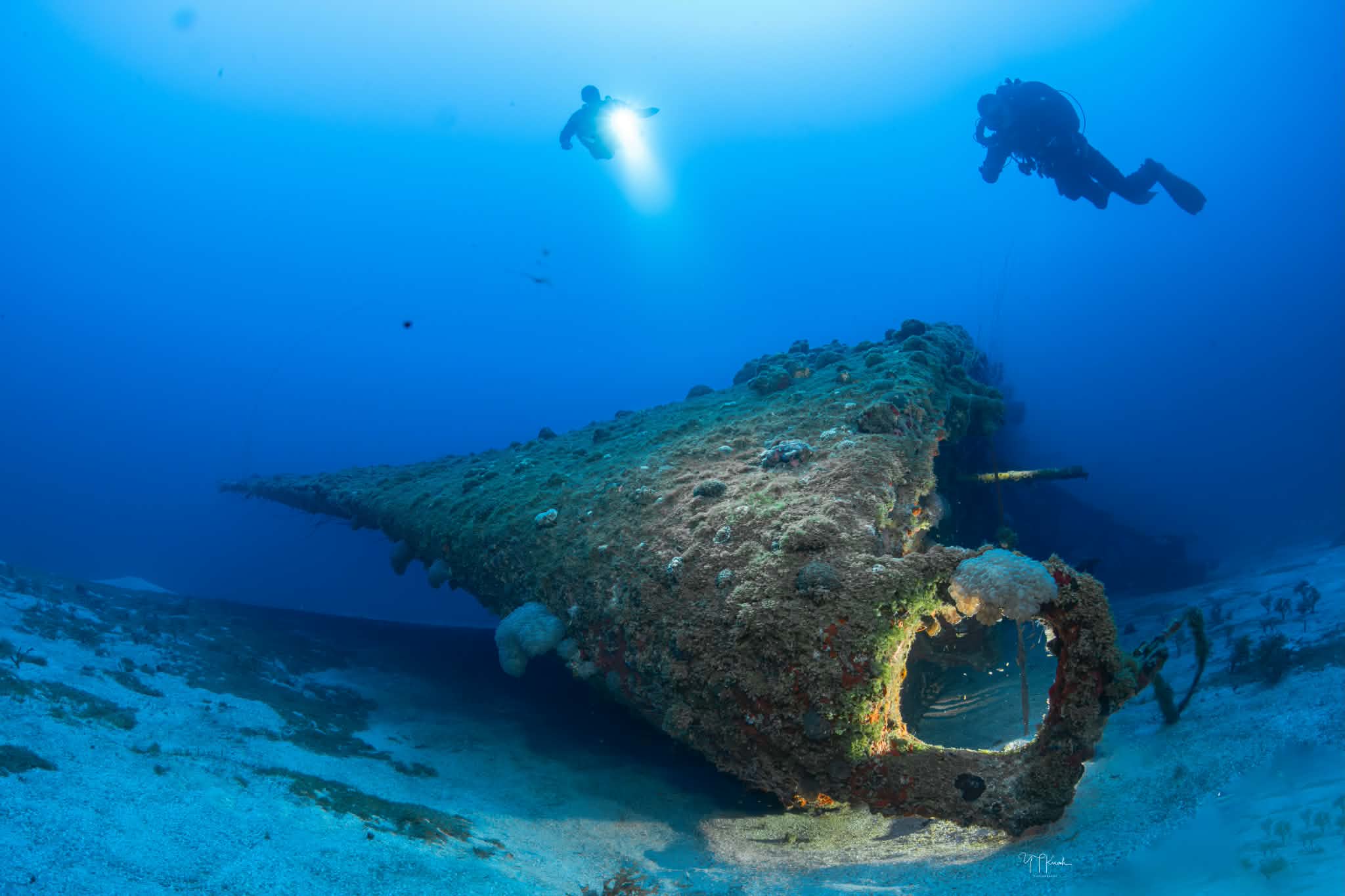
 On many of the wrecks you visited, strange pyramid-shaped structures are welded onto the decks, which divers call 'Christmas trees'. What is the story behind these steel Christmas trees, and what was their function during the atomic explosions?
"During the tests, the scientists wanted to measure exactly what effect the enormous blast wave had. They did that with relatively simple, analogue devices: the so-called burst disks. These were discs of aluminium foil of various thicknesses and diameters. These disks were mounted on the Christmas trees: pyramid-shaped steel structures that were welded onto the decks specially for the tests. You can still see those structures on the wrecks today. After the explosions, the disks were inspected straight away by scientists, and for the ships that sank immediately, this was done later by navy divers."
The wrecks in Bikini Atoll lie deep and the dive times are long. That calls for serious equipment. What kind of diving gear do you use to make such dives safely? Do you use rebreathers or specific gases, for example?
"The tests were deliberately held in the lagoon, so that the ships hit would not disappear into the bottomless depths of the Pacific Ocean and navy divers could still reach them. The bottom of the lagoon lies at around 55 metres everywhere. For the average recreational diver that is unreachable, but for technical divers with a rebreather that depth is manageable. The big advantage is that you can easily achieve a bottom time of well over an hour.
Because there is absolutely no recompression chamber as back-up at that location in case of decompression sickness, we dived extremely conservatively. For those in the know: we used a High Gradient Factor of 50 or 60, which is exceptionally low. Because of that built-in safety margin, the decompression times were very long (often more than an hour), which led to a total dive time of around 135 minutes per dive.
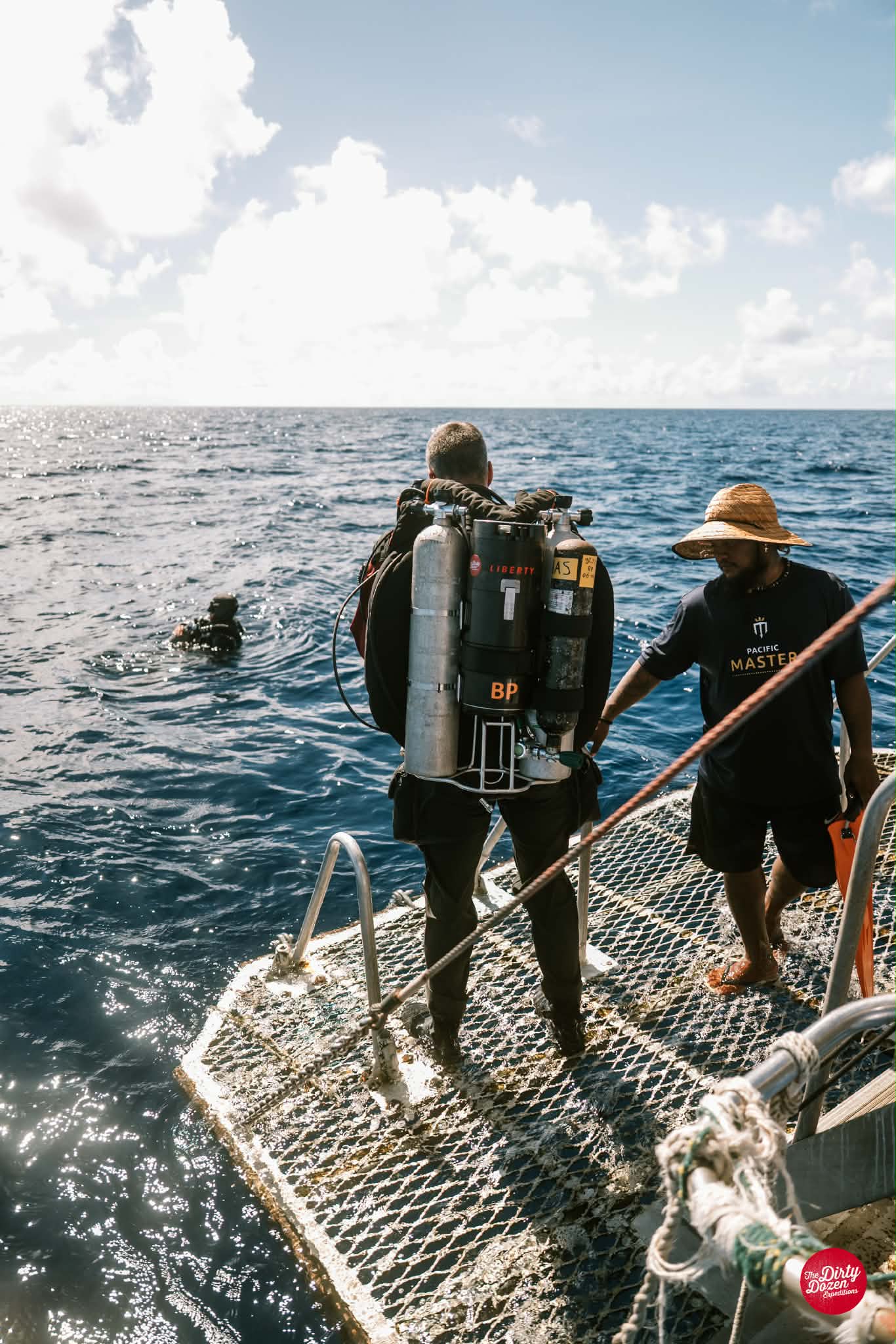
Most expedition members dived with a rebreather, although a few had to switch to Open Circuit out of necessity because parts were missing. I flew my Divesoft Liberty CCR myself. We used Trimix 16/45 as diluent, a deep bail-out of 18/45 and EAN50 as decompression gas. For safety, there was also a permanent deco station hanging beneath the boat with extra EAN50 and 100% oxygen for emergencies."
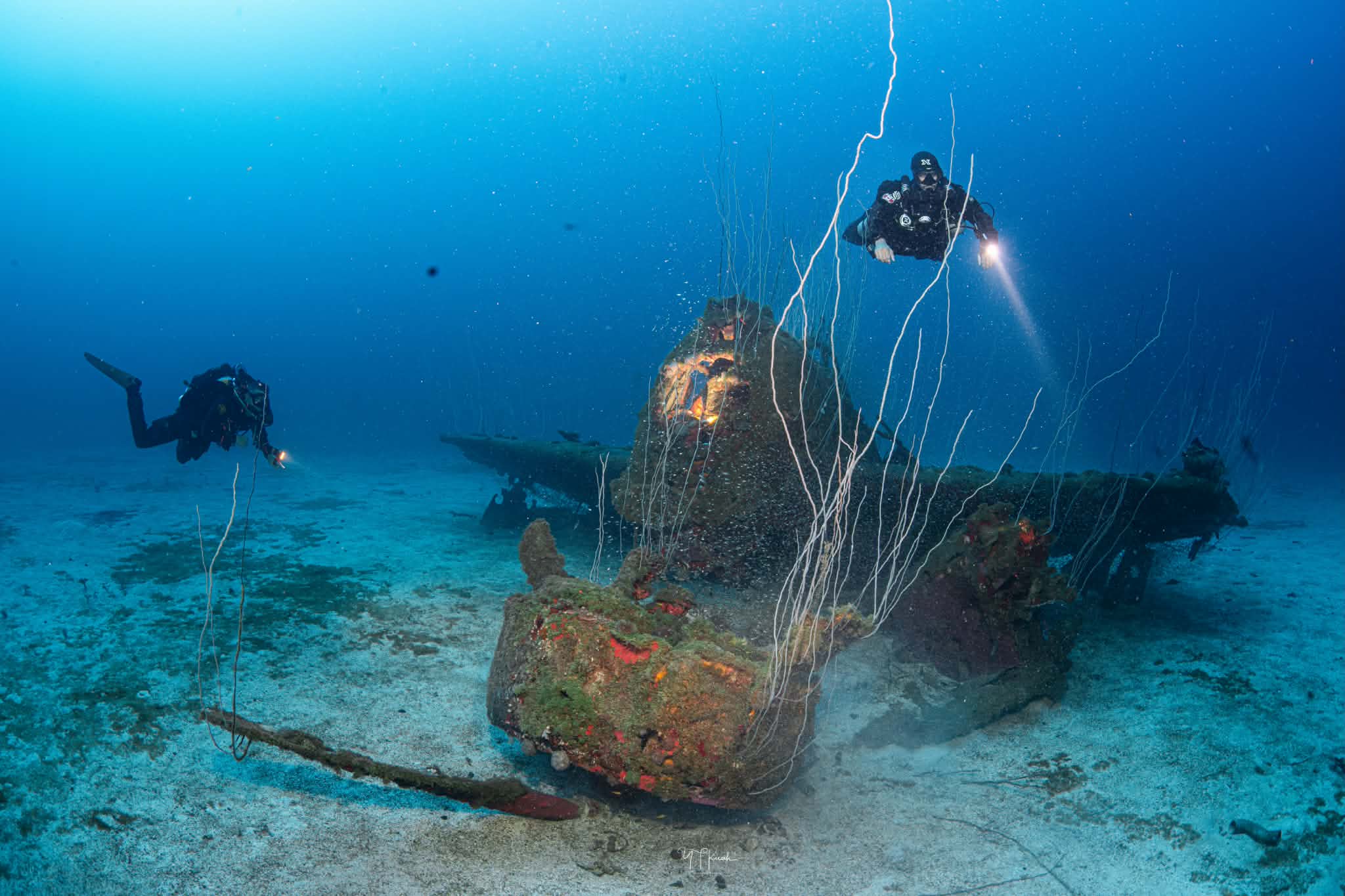
 Let's turn to the ships themselves. One of the absolute showpieces there is the HIJMS Nagato, the former flagship of the Japanese Admiral Yamamoto. You hovered there face to face with the gigantic 16-inch naval guns. What goes through your mind as you float past such monumental war machinery?
"At 215 metres in length, the Nagato is truly a gigantic battleship. It was the symbol of power of the Japanese navy. The impact of the Japanese battleships during the war was actually fairly limited; Japan mainly kept its capital ships in reserve so that it could strike back quickly from a great distance in the event of an American breakthrough. The fact that the Americans captured precisely this ship and destroyed it with an atomic bomb was the ultimate piece of geopolitical powerplay: the ultimate symbolic revenge for the attack on Pearl Harbor. America was drawn into the war because of this ship, and symbolically, the war came to an end at this ship too.
It was also the very first ship in the world to be fitted with fearsome 16-inch guns. That 16 inches refers to the inner diameter of the barrel: nearly 41 centimetres! At the time, they were surpassed in size only by the legendary Yamato. When you float past in absolute silence, you feel the enormous historical value of that place very intensely."
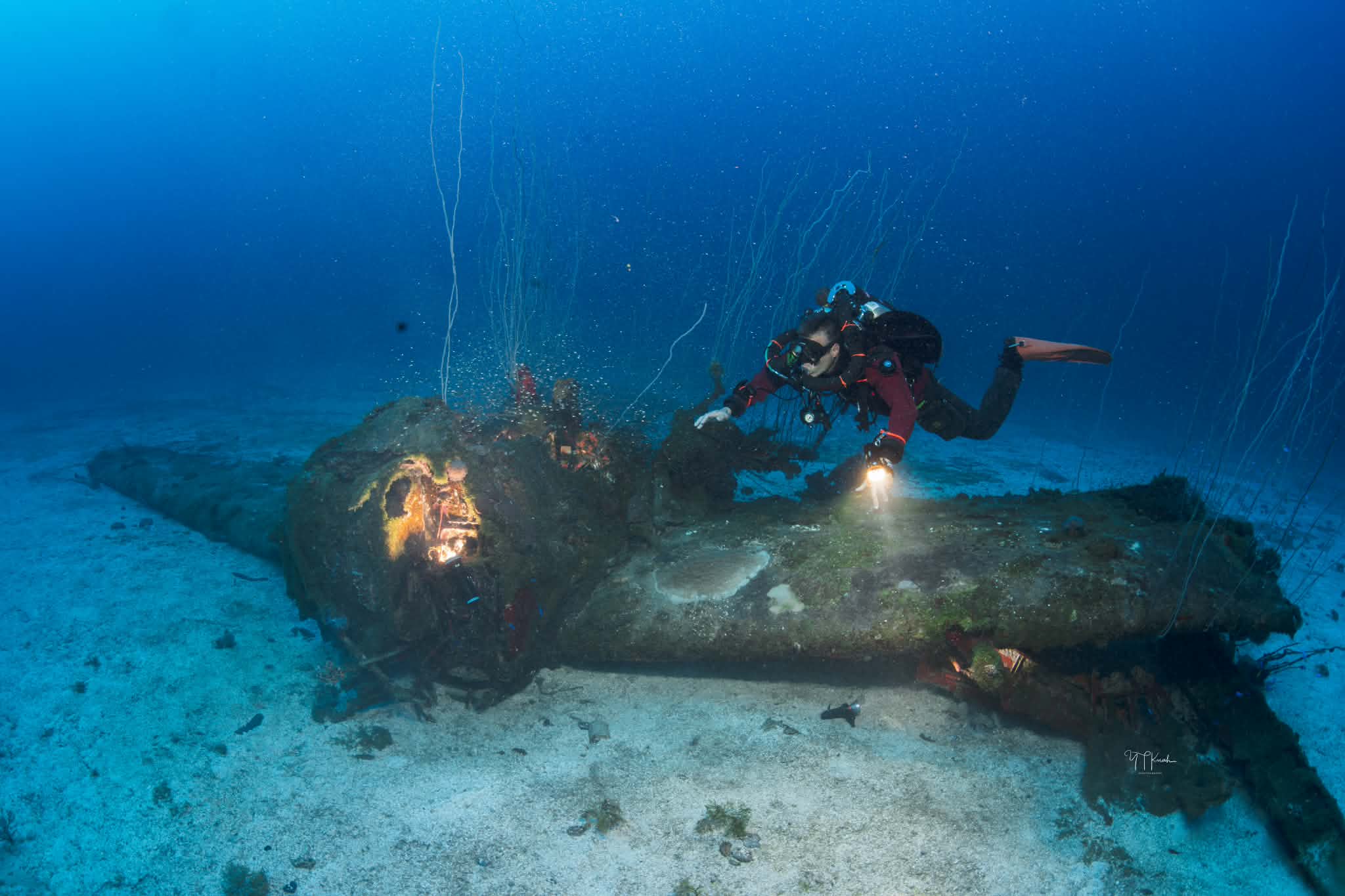
 The Nagato lies completely upside down on the seabed. Even so, you shared a wonderful, almost homely detail from the ship: rice cookers the size of a bathtub! What was it like to see them, and how does something like that suddenly bring the human side of a crew of 1,800 sailors so close?
"Like almost all battleships, the Nagato lies upside down. That is due to the enormous weight of the gun turrets. Because the wreck rests on those turrets, you can swim underneath it. The ship is accessible in several places, so we actually went inside. We swam straight through the ship from one side to the other and passed through the galley, the ship's kitchen, on the way. There we found four enormous rice cookers. Two of them were still attached to the deck and so were literally hanging above our heads. The other two had come loose and were lying on the floor. They were so gigantic that you could easily have taken a bath in them. The saying 'it takes an army to feed an army' suddenly became very tangible."
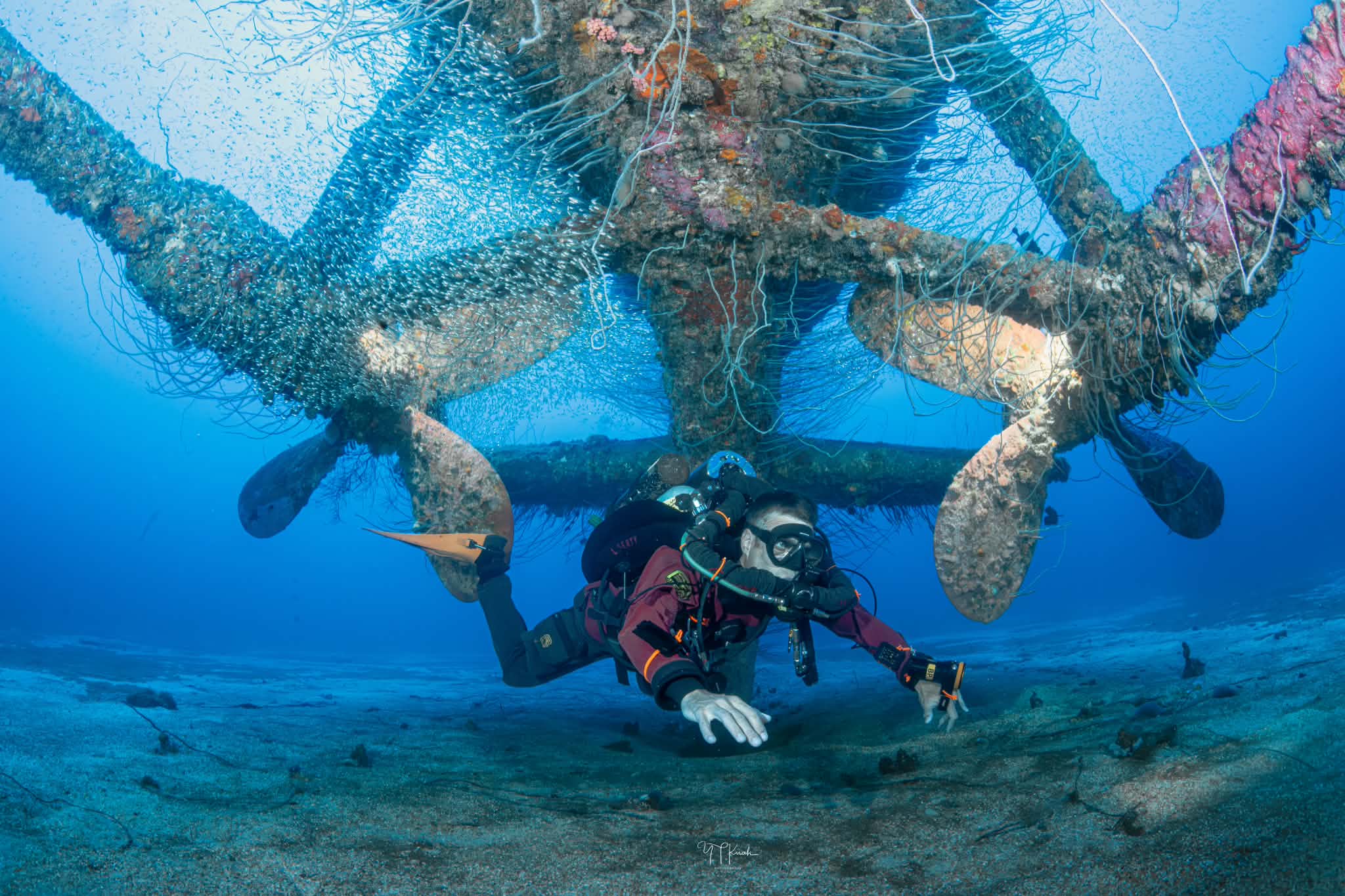 On to the American fleet: the aircraft carrier USS Saratoga. There you made a deep penetration of up to 60% into the ship, all the way to the sickbay to visit the dentist's office. What is it like to navigate the corridors of such a giant, knowing that complete aircraft on the deck outside were blown away by the blast?
"Yes, the Saratoga… My goodness, what a gigantic wreck. At a length of almost 300 metres, it is downright impressive. Via the elevator shaft, which was used at the time to bring the aircraft up to the deck, you can descend deep into the wreck and make various penetrations from there. An aircraft carrier like that is in effect a floating village, complete with all the facilities that come with it. So there is also a complete hospital and a dental practice on board. That last one was at the top of my bucket list.
The Saratoga is one of the few wrecks where permanent guidelines have been installed, comparable to the lines in some caves. To reach the Dentist Office, you first had to go some 50 to 100 metres into the wreck and pass through several doors. Then it was down a staircase, a 180-degree turn, and about 30 metres back again on a deck below. That was a serious penetration that demanded the utmost of your wreck diving techniques. You work with arrows and cookies and make a jump from one guideline to another on a lower deck. Placing markers correctly and having perfect trim and fin technique are crucial. If your technique is not in order, the silt stirred up means you will soon be unable to see your hand in front of your face on the way back. You were therefore only allowed in if you held a full cave diving qualification or the Advanced Wreck Diver certification."
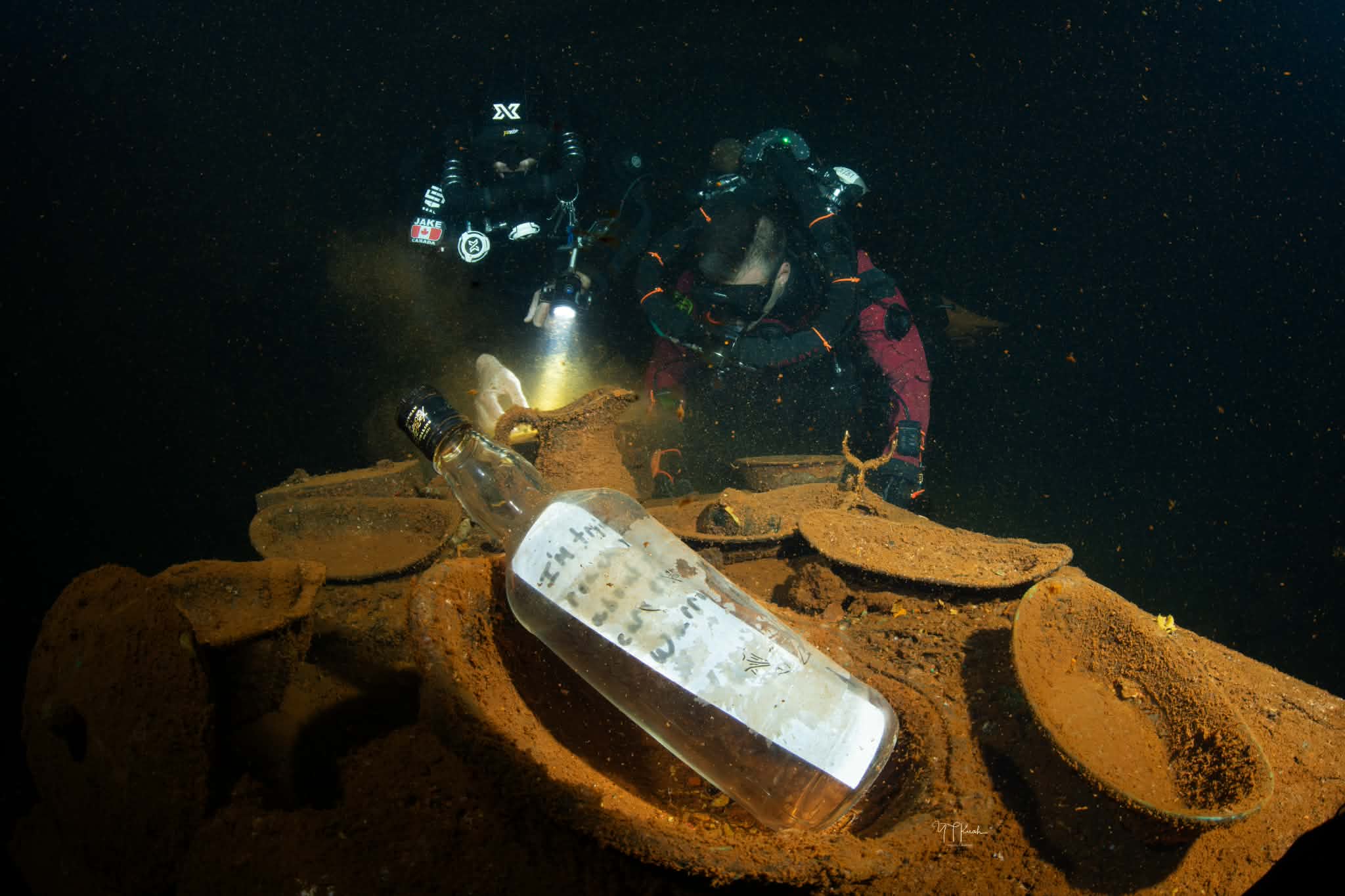 You asked in amazement on Facebook: "Have you ever seen a molten shipwreck?!" That was about the USS Gilliam. This ship lay directly beneath the hypocentre of the Able atomic bomb. What did you find on the bottom there? Is it true that the bow and stern are no longer even recognisable?
"The Able atomic bomb missed its actual target by half a mile (well over 700 metres) and therefore exploded directly above the USS Gilliam, a 130-metre-long military cargo ship. The destructive force hit with full impact. Within a fraction of a second the ship was flattened like a pancake and largely melted. Underwater, you really only find a flattened heap of debris; visually, it is not even the most interesting dive. Large parts of the steel hull plating turned liquid from the heat and now look like softened slabs of cheese. Only from a more or less recognisable anchor could we deduce what had presumably been the bow. Otherwise the front and the back could no longer be told apart at all. When I surfaced after the dive and looked up into the clear blue sky, it flashed through my mind: right here, above my head, an atomic bomb went off eighty years ago. A bizarre and surreal thought."
 At the destroyer USS Lamson we saw something very hair-raising in your video footage: a torpedo launcher with the live 21-inch Mark 15 torpedoes still in it, hanging half out from the blast. Isn't it incredibly tense to swim past that, or does historical fascination prevail?
"The ships were deliberately fully operationally equipped for the tests, including live ammunition, fuel and oil. At the USS Lamson, that became very tangible: the enormous torpedoes were still partly hanging in their launcher, and the depth charges were also still lying on deck. Remarkably, they did not explode prematurely at the time because of the enormous shock wave of the atomic bomb. That ammunition has now been lying on the bottom for eighty years and in principle does nothing any more, as long as you keep away from it. Of course, you don't go hitting it with a hammer. I didn't feel fear, but rather a deep awe for the ship and its history. In preparing for this trip I read up thoroughly on the wartime records of these ships. When you know which naval battles they took part in during their military careers, a dive like that gains an enormous extra dimension."
 On a single trip you got to dive the Prinz Eugen, Nagato, Anderson, Saratoga, Apogon, Gilliam and Lamson: an unreal list. When visitors come to your presentation at Duikvaker 2027, what do you hope they will really take home from your story about Bikini Atoll, beyond the spectacular footage?
"The atomic bomb tests at Bikini date from a completely different era. A time when apparently anything was possible and permitted, with extreme excesses like these as a result. These tests immediately ushered in the Cold War and show what extreme things humanity is capable of. We also must not forget that these islands were inhabited at the time. The local population was asked 'kindly but urgently' to pack up and go and live somewhere else. They were given provisions for a few months, were allowed to load up their canoes, and then their homeland was blown up. That is something we can absolutely no longer imagine today. I hope that, besides the wonder at the impressive wrecks, visitors also take home that bit of historical reflection."
Want to hear more about Bas's impressive diving expeditions? Visit his presentation at Duikvaker, on Saturday 6 or Sunday 7 February 2027 at 11:00 on stage 1.
At a glance
- What
- Interview with technical diver Bas Poelmann about his wreck diving expedition to Bikini Atol, which he presents at Duikvaker 2027.
- When
- Presentation on Saturday 6 or Sunday 7 February 2027 at 11:00. Duikvaker runs 5 to 7 February 2027. The atomic tests took place in 1946.
- Where
- Stage 1 at Duikvaker. The expedition took place at Bikini Atol in the Marshall Islands, Pacific Ocean.
- Who
- Bas Poelmann, technical diver, with Dirty Dozen Expeditions led by Mark Powell, an expedition group of eleven divers.
- Why
- Bikini Atol holds a large collection of wrecks from the 1946 atomic tests, including the Nagato, Saratoga, Gilliam and Lamson, and has a heavy history.
- How
- Using Divesoft Liberty CCR rebreathers with Trimix and EAN50, conservative decompression (gradient factor 50 or 60) and a ten-day expedition ship trip.
Key facts
- Duikvaker 2027 takes place on 5, 6 and 7 February 2027.
- Bas Poelmann dived Bikini Atol with Dirty Dozen Expeditions, led by Mark Powell.
- Operation Crossroads in 1946 used two atomic bombs, Able and Baker.
- Able sank five ships, Baker sank six.
- The lagoon floor lies around 55 meters deep.
- Total dive time was about 135 minutes per dive.
- HIJMS Nagato is 215 meters long and lies upside down.
- USS Saratoga is almost 300 meters long and has permanent guidelines.
Frequently asked questions
When and where can I see Bas Poelmann's Bikini Atol presentation?
When and where can I see Bas Poelmann's Bikini Atol presentation?
Why did the Americans test atomic bombs at Bikini Atol in 1946?
Why did the Americans test atomic bombs at Bikini Atol in 1946?
How deep are the Bikini Atol wrecks and what gear is needed?
How deep are the Bikini Atol wrecks and what gear is needed?
How long does it take to get to Bikini Atol?
How long does it take to get to Bikini Atol?
What are the Christmas trees on the Bikini Atol wrecks?
What are the Christmas trees on the Bikini Atol wrecks?
Keywords
- Bikini Atol duiken
- wrakduiken Bikini Atol
- Bas Poelmann Duikvaker
- Operation Crossroads wrakken
- HIJMS Nagato duiken
- USS Saratoga wrak
- Dirty Dozen Expeditions
- technisch duiken rebreather
- Duikvaker 2027 presentatie